
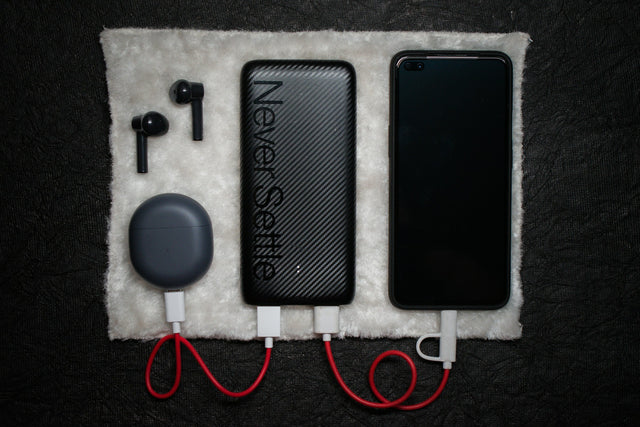
Do you absolutely need a power bank while living in Japan? Three real-life scenarios will tell you
Whether living or traveling in Japan, your mobile phone is basically your transportation card, map, translator, and wallet.
If you run out of power at an unfamiliar station or on a street, you can't even check routes or display e-tickets, instantly throwing your entire day's itinerary into chaos. This is why more and more Japanese users consider power banks an "essential item," not just a dispensable accessory.
1. Japanese office workers: Without power, you can't even find your way home.
In cities like Tokyo, Osaka, and Nagoya, office workers commute by subway or JR every day, with commutes often exceeding 30 minutes.
During this time, many people use their phones to watch dramas, browse social media, and reply to work messages. After work, they still need their phones to check transfer routes, read restaurant reviews, and pay with cashless payments.
The problem is, aging phone batteries, weather changes, or background apps running can easily cause the battery level to drop below 30% by the afternoon.
If you're working overtime, having a dinner party, or a last-minute meeting, without a power bank, you're forced to rely on "power-saving mode" all the way home.
A lightweight power bank allows Japanese office workers to turn their commute into a worry-free leisure time, instead of constantly monitoring the battery percentage.
2. International Students and Freelancers: Your Phone is Your Work Tool
For international students, freelancers, or content creators, phones and tablets are not just for entertainment, but for work.
You might need to use your phone to receive school notifications, manage social media accounts, take photos, and instantly reply to client messages.
This usage pattern typically consumes more power than that of typical office workers. Plus, you often move between cafes, co-working spaces, and libraries, where not every place has a usable outlet.
Without a power bank, even if you still have time and inspiration, you're forced offline by the battery.
Carrying a reliable power bank allows your work rhythm to be unrestricted by outlets, truly enabling you to work wherever you want.
3. Tourists and Short-Term Travelers: A Portable Power Bank is Your "Travel Insurance"
One of the biggest fears when traveling independently in Japan is running out of battery in unfamiliar territory.
You might be using Google Maps to find your accommodation, using a translation app to communicate with shopkeepers, or showing your online reservation QR code for entry, when suddenly your phone goes black. This is not only embarrassing, but you might even get lost.
Many travelers say, "There are plenty of convenience stores in Japan; I can just buy one on the spot."
Indeed, you often see portable power banks in convenience stores, but they are usually expensive, have limited selection, and you don't know in advance whether they will be out of stock that day.
Instead of scrambling to buy one at the last minute, carefully selecting a portable power bank with the right capacity, weight, and specifications before or after arriving in Japan will save you a lot of trouble.
4. Why Not Just "Rent a Battery"?
There are many portable power bank rental services available in Japan now, with machines in train stations, shopping malls, and convenience stores.
-
This service is helpful in truly urgent situations, but it has several limitations in the long run: The accumulated costs can be expensive, especially for frequent users.
-
Power banks aren't available in every area, and popular tourist spots often show "fully booked."
-
Unfamiliar brands may have weaker output and slower charging speeds.
If you live in Japan long-term or visit frequently, bringing your own reliable power bank that meets Japanese safety certifications is more cost-effective and reassuring than renting or buying one randomly each time.
5. Summary: Power Banks are an Essential Amenity in Japan
For Japanese users, power banks are no longer just for heavy tech users; they are an essential everyday tool for anyone who relies on their phone.
Whether you're an office worker, student, freelancer, or traveler, if you spend several hours a day without a power outlet, you'll realize how inconvenient it is to be without a power bank.
In the next article, we'll start disassembling those incomprehensible numbers on power banks: mAh, W, USB-C, PD, so you can choose a power bank in Japan that goes beyond just appearance and price.